I’ve made a lot of bad vegetable soup in my life. Watery, gray, and mostly tasting like hot salt water, with a few sad vegetables floating around. If you’ve been there too, this recipe is for you.
Here’s what took me embarrassingly long to figure out: great vegan vegetable soup isn’t just about the ingredients. It’s about a few simple techniques that most recipes never bother to explain. So I’m going to explain them.
You’ll get a foolproof 30-minute Instant Pot method, the real reason each step matters, and actual nutrition facts instead of a vague “it’s healthy!”
Once you understand the why, you won’t need the recipe anymore. Let’s cook.
1. Why vegetable soup is so easy to get wrong
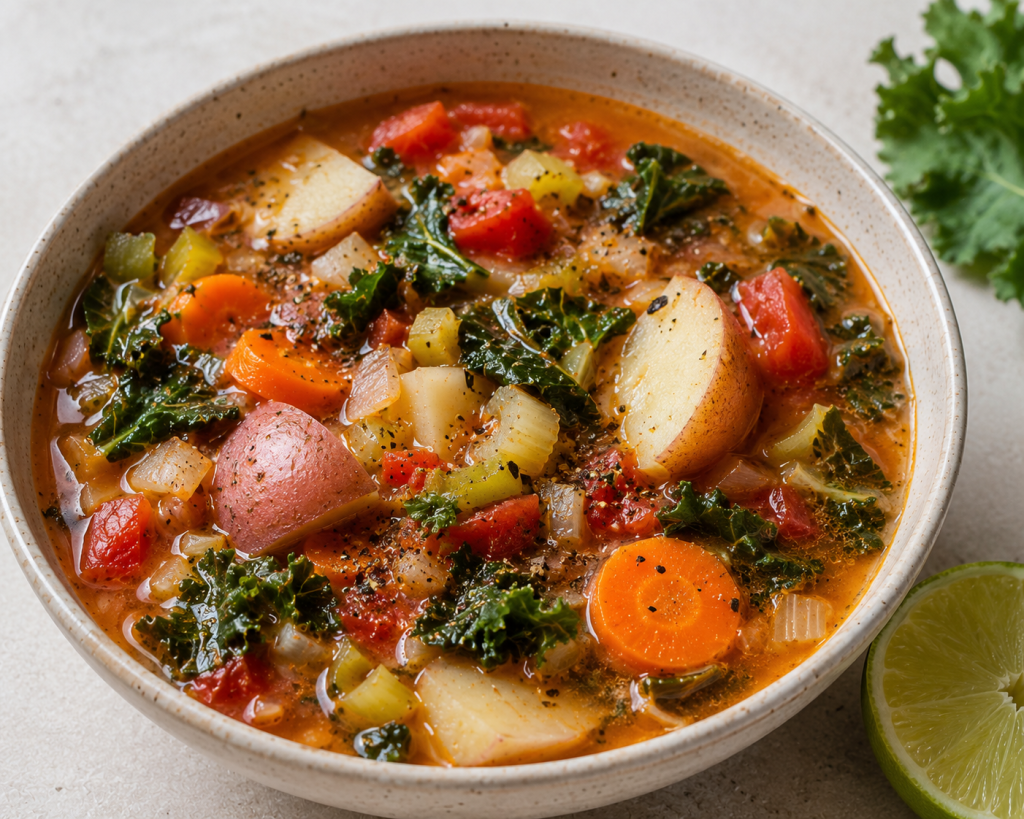
Vegan vegetable soup has a problem that meat soups don’t. There’s no chicken fat, no beef bones, no cream to smooth things over and cover your mistakes. It’s just plants and water. Every bit of flavor is something you have to put there on purpose.
Sounds harder. In practice, it just means you have to nail three things, and once you know what they are, they’re not hard at all.
First, browning. When you cook onions, carrots, and celery until they go golden, they develop a deep, roasted, almost sweet flavor. That’s the Maillard reaction, if you want the technical name for it, and it’s the single biggest thing separating soup that tastes “boiled” from soup that tastes “cooked.” Most people skip it or rush it. Don’t.
Second, umami. This is the savory, meaty depth you’d normally get from animal products. In a vegan soup you build it from plants instead: tomatoes, kale, and a broth worth its salt are all loaded with it.
Third, acid. A squeeze of lime at the very end. It doesn’t make the soup taste sour, it makes everything else taste sharper and more alive. Skip it and the soup tastes muddy even when you can’t say why. This is the tip almost nobody tells you, and it’s the one that’ll change your soup the most.
That’s the whole game. Keep those three in mind and the recipe below basically writes itself.
2. Why you’ll actually make this again
A few honest reasons this one earns a spot in your rotation.
It’s genuinely fast. Three minutes under pressure, maybe 30 minutes start to finish once you count prep and the time the pot takes to come up to pressure. Faster than delivery.
It uses whatever you’ve got. Half a zucchini, a handful of green beans, that one lonely sweet potato. This soup is a template, not a strict recipe, and it’s happiest cleaning out your vegetable drawer.
It’s cheap. We’ll do the actual math later, but carrots, celery, onions, and potatoes are about the cheapest food on the planet.
And it’s filling in a way the calorie count doesn’t explain, which comes down to fiber. More on that below too.
3. What you need
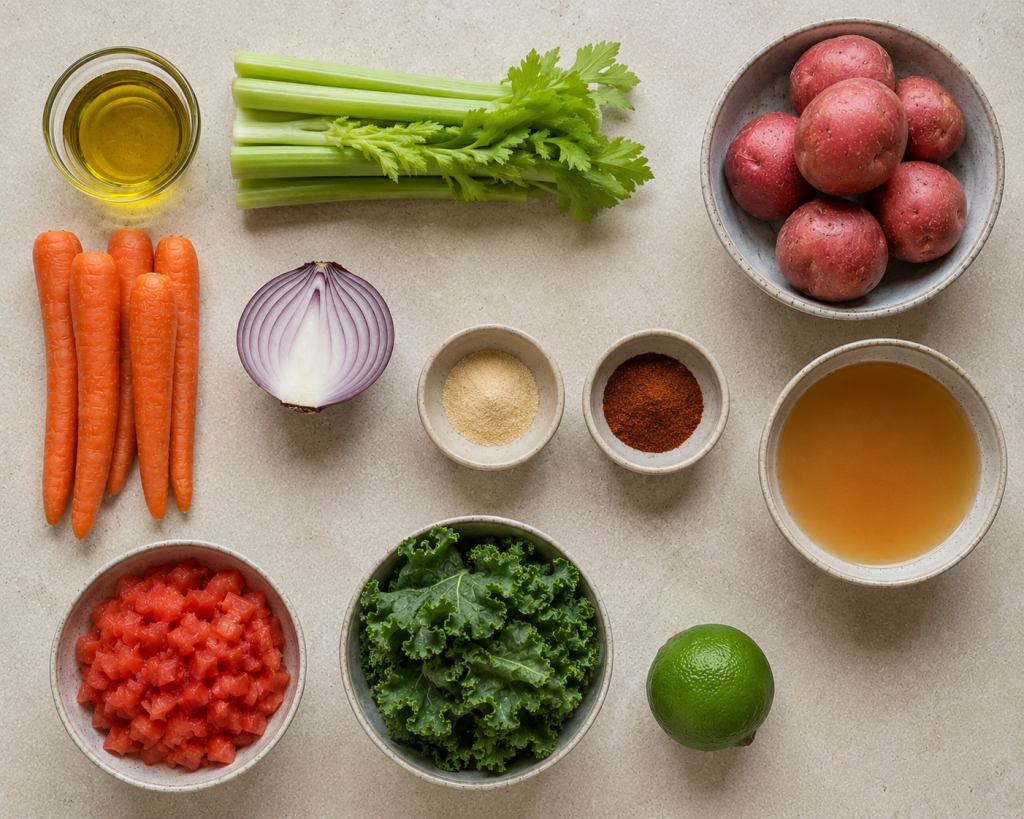
Here’s the full list, with a quick note on what each thing is actually doing. Once you know the job, swapping things out gets a lot less scary.
| Ingredient | Amount | Its job |
|---|---|---|
| Extra virgin olive oil | 1 tbsp | Lets the veg brown, carries flavor |
| Celery, chopped | 4 large stalks | Savory, herbal backbone |
| Carrots, sliced | 4 large | Sweetness and color |
| Red onion, chopped | 1 medium | The base of the whole thing |
| Garlic powder | 1 tsp | Mellow garlic, no burning |
| Chili powder | 1 tsp | A little warmth |
| Sea salt & black pepper | To taste | Season as you go, not just at the end |
| Vegetable broth | 6 cups | The backbone, and your main umami |
| Red potatoes, quartered | 1 lb | Body, and that filling quality |
| Bay leaves | 2 whole | Quiet background depth |
| Cherry or grape tomatoes, chopped | 1 pint | Brightness and sweetness |
| Baby kale, chopped | 2 cups | Color, nutrients, texture |
| Fresh lime juice | 2 tbsp | The finishing touch |
One thing worth saying about the broth, because it matters more than anything else on this list. In a vegan soup the broth is doing the work that meat and bones do elsewhere. If it tastes thin and over-salted straight from the carton, your soup will taste that way too. Taste it first. If you’d happily drink it on its own, you’re good.
4. How to make it, step by step
Looks like a lot of steps. It isn’t. Most of your job is chopping, and the pot does the rest.
4.1. Start with the sauté
Add the olive oil to your Instant Pot and hit “Sauté.” Once it’s warm, in go the celery, carrots, onion, garlic powder, and chili powder. Season well with salt and pepper and give it a stir.
Salting now, not later, actually matters. The salt pulls a little moisture out of the vegetables so they brown instead of steam. And the oil spreads the flavor of the chili and garlic powder around the pot. This is the foundation, so don’t rush it, this is where most home cooks lose the plot.
4.2. Let it get golden
Keep going, stirring now and then, until the whole kitchen smells great and the vegetables are just starting to turn golden at the edges. About 4 to 5 minutes.
Those golden edges are the flavor. You’re not burning anything, you’re building all that roasted, savory depth that plain boiling could never give you. Stop too soon and the soup falls flat.
Now pour in the broth and stir, and make sure you scrape up every brown bit stuck to the bottom. Those bits are pure concentrated flavor, and scraping them loose is also how you dodge the dreaded “burn” message later. Then turn the pot off.
4.3. Add the potatoes, tomatoes, and bay
Drop in the quartered potatoes, the bay leaves, and the chopped tomatoes. Lock the lid on, set the valve to “Sealing,” and pressure cook on “Manual” for 3 minutes.
Yes, 3 minutes. Under pressure, water gets hotter than its normal boiling point, so things cook fast. And red potatoes are waxy and low in starch, so they hold their shape instead of falling apart the way a russet would. Just keep the pieces roughly the same size so they cook evenly.
4.4. Let the pressure drop on its own
When it’s done, leave it alone for 10 minutes to release naturally, then release whatever’s left by hand.
That wait isn’t wasted time. As the pressure comes down the soup keeps cooking gently, and a little starch from the potatoes thickens the broth so the whole thing feels less watery. Rush it with a quick release and you get thinner soup and roughed-up potatoes.
4.5. Finish with kale and lime
Take the lid off, fish out the bay leaves, and stir in the kale and lime juice.
The kale goes in at the very end for a reason: a lot of its vitamin C and color don’t survive long cooking. The leftover heat wilts it in under a minute while it’s still bright green and still good for you. The lime, like I said earlier, is what pulls the whole bowl into focus.
Taste, fix the salt and pepper, and serve. That’s it.
5. What’s actually in a bowl
Here’s where most recipes wave their hands and say “healthy.” Let’s look at real numbers instead.
On these numbers: these are my own estimates based on standard ingredient data, not lab testing, and they’ll shift with the exact brands and amounts you use. If you’ve got specific dietary or medical needs, run your own ingredients through a nutrition calculator or talk to a dietitian. I’m a home cook, not a nutritionist.
Roughly, per serving, assuming the pot makes 6:
| Per serving | Why you care | |
|---|---|---|
| Calories | 160–190 | Light, but genuinely filling |
| Protein | 4–5 g | Real, but modest (fix below) |
| Fiber | 6–7 g | About a quarter of your day |
| Carbs | 30–34 g | Mostly slow-burning, from the potato |
| Fat | 3–4 g | Nearly all from the olive oil |
| Vitamin A | 200%+ DV | Carrots and kale |
| Vitamin C | 60–80% DV | Tomatoes, kale, the lime |
| Vitamin K | 100%+ DV | Kale is loaded with it |
The number that matters most is fiber against calories. Six or seven grams of fiber for under 200 calories is a lot, and it’s why a bowl of this keeps you full way longer than the calorie count would suggest. Fiber slows everything down and keeps your blood sugar steady.
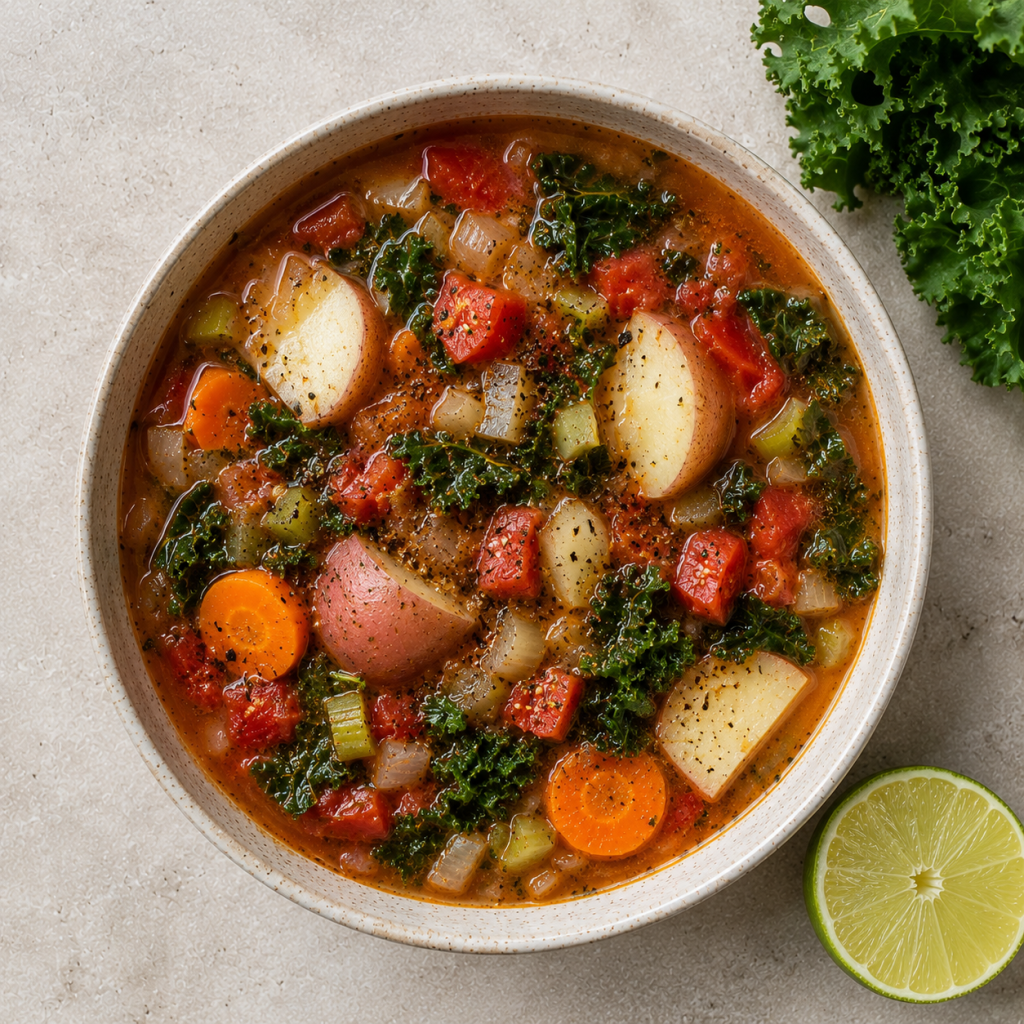
The one to watch is protein. Four to five grams isn’t much, which is fine for a plain vegetable soup, but it won’t carry a whole dinner on its own. Easy fix, and it’s in the next section.
6. The actual cost
Recipe blogs never do this, so here’s the math.
On these prices: rough estimates based on average US grocery prices when I wrote this. They swing a lot by region, season, store, and country, so treat it as a ballpark.
| Item | Cost |
|---|---|
| Olive oil | $0.15 |
| Celery | $0.60 |
| Carrots | $0.50 |
| Red onion | $0.40 |
| Spices | $0.20 |
| Vegetable broth | $2.50 |
| Red potatoes | $1.20 |
| Tomatoes | $2.00 |
| Baby kale | $1.50 |
| Lime | $0.40 |
| Total | ~$9.45 |
Split across 6 bowls, that’s about $1.58 a serving. For a filling, homemade, nutrient-dense meal, that’s tough to beat. The broth and tomatoes are your priciest lines, so buying broth in bulk or using canned tomatoes brings it down further.
7. A few tips that make a real difference
Season in layers. Salt during the sauté, then taste and fix it again at the end. Salt added early works its way into the vegetables in a way you can’t fake with one pinch at the finish.
Don’t skip the lime. If your soup tastes “fine but boring,” it’s almost always missing acid, not salt. No lime? Lemon or even a splash of cider vinegar does the same job.
Cut the potatoes evenly. Same-size pieces cook at the same speed. Otherwise you get mush and crunch in the same spoonful.
Always scrape the bottom before sealing. It’s better flavor and it stops the burn warning. Takes ten seconds.
Let it sit if you can. Even ten minutes off the heat and the flavor deepens noticeably.
8. Make it your own
This is where it stops being my recipe and becomes yours.
Want it to fill you up? Stir in a drained can of white beans, chickpeas, or lentils at the end. That alone takes it from about 4 grams of protein a serving to 12 or more, and turns a light soup into an actual meal. Cubed tofu works too.
No baby kale? Spinach, chard, or shredded cabbage all work. Sturdier greens like chard can go in a couple minutes earlier.
More veg? Zucchini, green beans, corn, peppers, mushrooms, frozen peas, all welcome. This soup is where leftover produce goes to be useful.
More or less heat? Toss in some red pepper flakes or a diced jalapeño with the aromatics, or leave out the chili powder for a mild version the kids will eat.
More savoriness? A spoon of tomato paste, a splash of soy sauce or tamari, or some nutritional yeast all add that deeper, richer note.
9. Storing and reheating
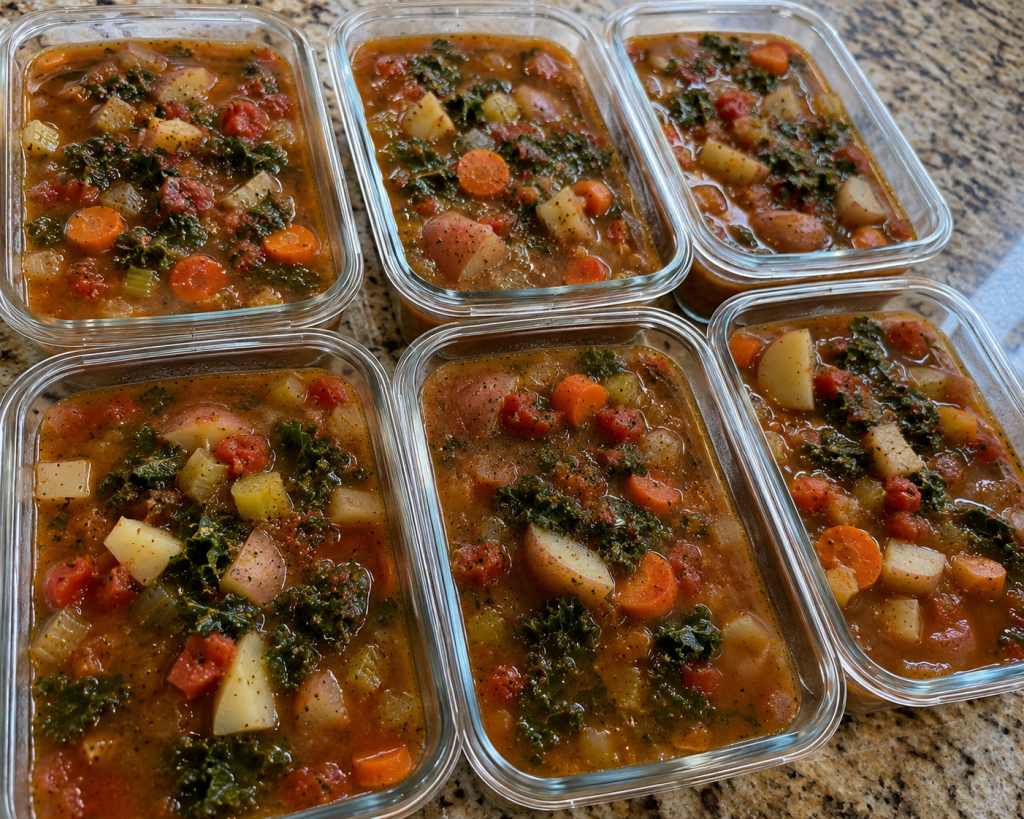
This is a meal-prep dream, and there’s a reason it gets better with time.
- Fridge: keep leftovers in an airtight container for 4 to 5 days. It genuinely tastes better on day two, because the flavors have had time to spread evenly through the liquid and the potato starch has fully soaked in. That “it’s better tomorrow” thing is real, not kitchen folklore.
- Freezer: freezes well for up to 3 months. If you know you’re freezing a batch, slightly undercook the potatoes, since they soften more on reheating. Freeze it in single portions and lunch sorts itself out.
- Reheating: warm it gently on the stove or in the microwave. If it thickened up in the fridge, loosen it with a splash of broth or water. And add a fresh squeeze of lime, acid fades over time, so a little more wakes it right back up.
10. Questions people ask
Over the years of making this soup, a handful of the same questions keep coming up. Here are the ones people ask most, along with the quick answers.
10.1. Can I make this without an Instant Pot?
Yep. Sauté the veg in a big pot on the stove, add the broth, potatoes, tomatoes, and bay, and simmer until the potatoes are tender, around 20 to 25 minutes. Kale and lime at the end, same as always.
10.2. Is it gluten-free?
As written, yes, as long as your broth is certified gluten-free. Some sneak in wheat, so check the label.
10.3. Can I use frozen vegetables?
Sure. Straight from the freezer, no real change to the timing. They’re frozen at peak ripeness, so they hold up nutritionally.
10.4. How do I make it a full meal?
Add beans, lentils, or tofu, and serve it with crusty bread or a grain on the side. The beans alone roughly triple the protein.
10.5. Why did I get a burn warning?
Food stuck to the bottom before the pressure built. Next time scrape up all the brown bits when you add the broth, and make sure there’s enough liquid in there.
10.6. It tastes flat even though I followed the recipe. Why?
Nine times out of ten it’s missing acid or under-salted, not missing an ingredient. Add the lime, then taste and adjust the salt. The difference is bigger than you’d think.
10.7. Can I make it oil-free?
Yes. Sauté in a splash of broth or water instead of oil. You lose a little browning and richness, but it still works well for a low-fat approach.
11. One bowl worth learning by heart
The nice thing about really understanding a soup like this is that eventually you stop needing the recipe at all. Once browning, umami, and that finishing hit of acid make sense to you, you can look at a random pile of vegetables and turn it into something good without measuring a thing.
This particular one is fast, absurdly cheap at around a buck and a half a bowl, and a lot more nourishing than it looks. Make it by the book once, pay attention to why each step is there, and by the third or fourth time you’ll be winging it like you’ve done it forever.
Just don’t skip the lime at the end. You know why now.